
The ‘’Weather project’’ (2003-2004) by Olafur Eliasson
No matter from which side of the globe you experience life, the light that your days receive come from the same sun. The sun is, therefore, unifying our natural presence.
Olafur Eliasson, born in 1967, in Copenhagen, Denmark is known as an installation artist. This type of art carries the idea that a space can be renewed by changing the way humans perceive it. ’As a consequence (…) the meaning of an artwork does not necessarily lie within it, but as often as not arises out of the context in which it exists.’ (Archer, 2015, p. 8) To challenge this perception, the artist, who is trained as an architect, plays with elements that belong to the phenomenological world: water, light, ice, stone. What is of interest for him in his work, as he expresses in a TEDx presentation (Olafur Eliasson: Playing with space and light, 2009) is the possibility to offer an engagement with the space (in his definition, in the same video, he calls this ‘negotiation’) that translates into a given responsibility for humans that share that space. They can chose to interact or not but when they do some of the questions that the artist wants to follow them is ‘How do we know that being in the space makes a difference?’, ’Does it matter whether the actions I take filter us into a sense of responsibility?’ ‘What does it mean to be in a space?’
The ’Weather project’ was the fourth commission for the Tate Modern’s Turbine Hall and it attracted over 2 million visitors during the first 5 months of the exhibition.
What is of importance for me is the realization of an immersive and sculptural art piece by using mostly light and the invitation to be in the space. In the book ’Defining contemporary Art-25 years in 200 pivotal artworks’’ (Suzanne Cotter et all.2011, p. 330)), the experience is described like that: ’Entering the Turbine Hall from the west, one was enveloped in a foggy haze, at the end of which a vast glowing disc bathed the atmosphere in an orange –yellow light, resembling an impression sun setting on the horizon line of the steel bridge that divides the long perspective of the space. Mirrored panels lined a ceiling suspended some 30 meters above the floor, further diffusing the light into a disembodies glow that bleached the color from everything and everyone in the space, rendering all into a sepia-toned black and white’. The spectacle of that experience was created with the unity of different bodies covered in the same light and the contrasts of the huge shape of the sun and the very tiny shadowy shapes of the humans.
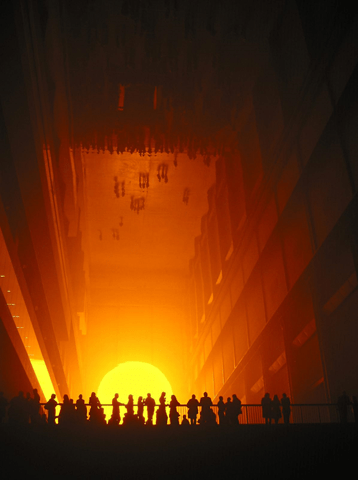
Jens Ziehe, Studio Eliasson, 2003
The medium was low-tech, monofrequency light on a stand projection foil, haze, machines, mirror foil, aluminum, scaffolding but the size was impressive 27x22x155m. The work of art invited everyone, so it managed to facilitate the shaping of an inclusive community. This excitement translated into a shared space, where people that formed the crowd or the public felt free to sit on the floor and react to their reflection on the above mirror, did yoga, joined with other individuals to create circles, run and did photos. All very different choices but accepting one another as a possibility to interact or active contemplate that space. In the same book, Cotter (2014, p.330) signalized ‘above and beyond the perceptual shifts generated by the project as an experiential event, its visible merging of the museum and public sphere signaled its more lasting legacy: the theatricality and regenerative expectations that have become cornerstones of large-scale commissioned artworks globally.’
As much as it is important to speak about the context an art piece creates, as important is to relate to the context in which the art is shaped. In this case, it is inside installation art field, but it is part of the bigger idea of climate change and the worry the artist has about how this will or in the present time affects humans. In ‘Art since 1989’ (Grovier, 2015, p.144) it is suggested Eliasson’s work had an apocalyptic emotion to it when put ’against a backdrop of increasing concern about the potential catastrophic effects of climate change and global warming, the artist dazzling alchemy of single elements into awesome spectacle was tinged with portentousness, as though he had built a mausoleum for the setting sun.’ This is playful considering that it happened in London, where the actual sun is not so controllable. Also, because as a process of building the piece, the artist devised a questionnaire that gathered answers for ‘Do you think tolerance to other individuals is proportional to the weather?’ ‘To what extent are you aware of the weather outside your workplace? The results were published in the catalogue accompanying the exhibition, which also included a roundtable discussion about the communication of art, meteorological reports of freak weather events, weather statistics, and a series of essays on the weather, time, and space.’(Studio Eliasson, 2019)
I feel inspired by artist’s idea of public space and the fact that he imagines his work with a somatic experience in mind for the participant. Moreover, Eliasson is not creating alone, he has a studio in Berlin, and he is helped by a team of craftsman and designer, so a lot of teamwork is involved in the creation of the various spaces participants arrive to feel as a community, or as Eliasson would put it a ’democracy’ (TEDx, 2009). These ideas pushed me to read about the democratic ideal from a philosophical point of view.
I arrived at John Dewey and his belief, in 1888, of democracy being the only ethical ideal of humanity. (Talebi, 2015 p. 20) The philosopher considers education an interaction between the human beings and the world and it seems that Olafur Eliasson want to educate his public and developed a very powerful voice, not only in his art but as a teacher for what museums can achieve if they stress their position as public spaces. In the future, my own work will need to play with scale and interaction as I feel carried towards large and immersive artworks and the idea that the viewer is activating the artwork. Again, the idea of presence and collective is important as it was in ‘The artist is present’.
Reference list
Archer, M. (2014), Art since 1960, 3rd edition, London: Thames and Hudson
TED (2009), Olafur Eliasson: Playing with space and light, Available at: <https://www.youtube.com/watch?v=WCGuG0uT6ks> (Accessed 2May 2020)
Cotter S. et all (2011), Defining contemporary art-25 years in 200 pivotal artworks, London: Phaidon
Grovier, K. (2015), Art since 1989, London: Thames and Hudson
Talebi, K. (2015), ‘John Dewey-philosopher and educational reformer’, European journal of education studies, Issue 1, Volume I, pp. 1-13, Available at: <https://files.eric.ed.gov/fulltext/ED564712.pdf > (Accessed 22 May 2020)
Studio Eliasson (2019), Available at <https://olafureliasson.net/archive/artwork/WEK101003/the-weather-project> (Accessed 2 May 2020).
Ziehe, J. (2003), The weather project, Available at <https://olafureliasson.net/archive/artwork/WEK101003/the-weather-project> (Accessed 2 May 2020)
 Petronela-Elisa Citea