
I discovered Ernesto Neto by searching artists that keep the playfulness of Eliasson but have the courage of Ambramović. Neto is born in 1964 and studied art in Rio, Brazil. His explored at the beginning of 80’s the roots of the group NeoConcrete movement. The art term invokes the need for sensuality, exploration of color and poetic language in concrete art. (Brazilian concrete movement started in 1950).
In the book ‘Contemporary art Brazil’ (editor Amirsadechi, 2012, p. 250)), Neto names as key influencers Hélio Oiticica’s parangolés (wearable colored sculptures) and Lygia Clark’s ‘The house is the body’ (1969-1969). His work varies from wearable participatory articulated sculptures to immersive paths done in polypropylene croquet that takes the participant in a bouncy journey above the ground.
One of the most exciting work for the audience is ‘Os’ Bicho SusPenso na Paisagen’, from 2011 with a size of 735x 4.465x 2.1 45. In the book mentioned before, this work is described as ‘including all the motifs of Neto’s later career, including drop-like shapes of sheer polyamide(…) suspended from the ceiling and filled with spices, some chosen for their color (saffron), others for their pungent scent (powdered clove, pepper)’
His philosophy is also explored on the same page: ‘I don’t think human beings have to be made for safety. That is not what life is about. Life is about instability’. When I read that I was terrified. But then, I started watching reactions from visitors and participants inside his artwork. They seem seduced by the smells, shapes and textures or the sculptures he builds. They come every time are around his studio to enjoy climbing inside the sculpture as if in a playground the feeling of climbing through what it seems a rainforest made of croquet. His visual identity is very much built on large crochet installations. The colors are vibrant, and I can read the play on the contrast between the fragility of the crochet technique and the powerful flexibility of such a long and suspended structure.
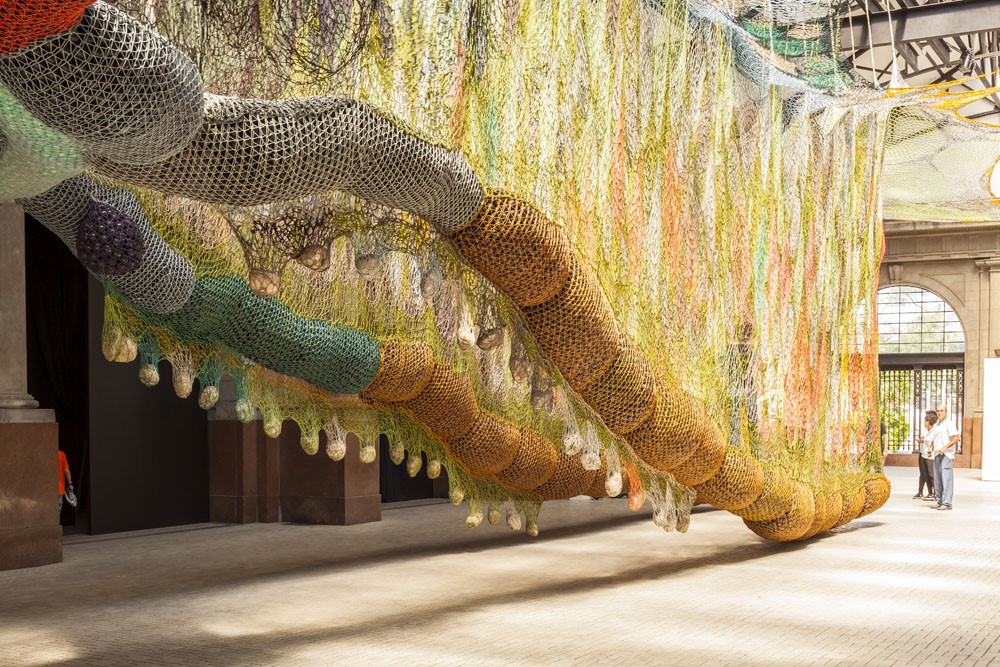
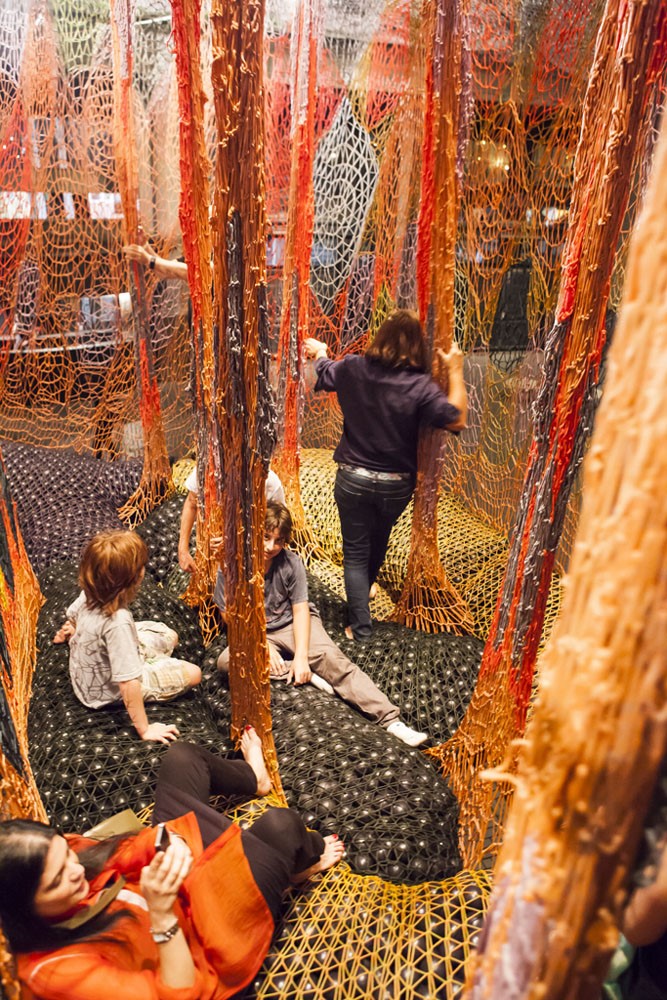
It makes me think, as we experienced the burning of a large part of the Brazilian rainforest that his artwork, by repeating the translucent structure of the wires of polypropylene, and giving it a vegetal ethos might repeat the natural lines and curves that the rainforest has. I wonder, if a person familiar with the rainforest will feel the same. In the same why, the question for the visitors of his artwork and for him would be if they visit the structure to laugh about their body tested physical instability and if, when standing behind someone that tries to find their balance, is a comfortable position, it pushes people to have patience with each other or not? The playful nature of this artist pushes me to add more colors into my work and maybe add some tea bags into the water for the acrylics just to experience smells I am familiar with in unusual settings as Brazilians experience a kind of rainforest of strings.
Reference list
Amirsadechi. H. et all (2012), Contemporary Art in Brazil, London: Thames and Hudson
Koenings, N. (2011), O Bicho SusPenso na PaisaGen, Available at
< http://revistacarbono.com/artigos/0bicho-suspenso-na-paisagem/ > (Accessed 29 May 2020)
 Petronela-Elisa Citea