
If there will be no artwork or artefacts or artists in a museum, then the people in that space will be just wandering among crowds. Spectators of their humane attributes and of the reality of stranger’s bodies being in the same space as their own. But if present, art gives a purpose to a crowd (this could be valid also for a landscape outside the museum’s context). Art creates dialogue. By accepting that, the artist is producing another quality of the verb ‘to be’. One that belongs to the esthetic of participation or the philosophy of dialogue. We are if we accept art can interact with our imagination and our bodies. Following this logic, the crowd contains not just individuals but possible interaction scenarios.
I am curious how artists negotiate the design of their artefact or their own presence inside the domain of interactive art so that the crowd has the possibility to express their presence in the art space. If the public’s involvement is seen as necessary, its role varies from visitor, viewer, participant, user, actor (actant), practitioner to performer or interpreter. What changes in the reception of the art piece if it contains participation? Can we still feel individuals if we experience art as part of a crowd? When the crowd becomes a community? What differences of design are between a performative art piece and a site-specific installation that focus on creating spaces of interaction? Was the focus on participation one of the answers artists had to historic events and social movements? As we see the Other be a participant in an art piece, do we satisfy our curiosity about our own moment of participation? What is left to be communicated in contemporary art in this era of multichannel communication? Many questions sent me on the construction of this blog. Mostly a need to develop my knowledge about contemporary art, the study of globalized art tastes and practices and the desire to visit this kind of exhibition in my mind while being in lockdown, with no more access to the emotional feeling of being present inside a crowd.
The idea to focus on the different artefacts and artists that create an encounter, not just esthetically with the experience of a well-crafted painting, drawing or a sculpture but also develop an activity that engages intentionally every visitor into a sensorial communication which speaks about a moment of shared humanity between strangers came from a book called ‘The other ‘ by Ryszard Kapuściński. Some of the vocabulary that the author explores about identity will be used in various parts of the blog. The main quote from Kapuściński (2018, p.57) that directs my work for this blog is ‘So here is my Other. If fate brings him into contact with some Other-Other to him-he will find three features of that Other the most important: race, nationality and religion. I have been trying to find a common factor in these features, to discover what links them. It is that each one of them carries a huge emotional charge, so big that from time to time my Other is incapable of controlling it, and then it comes to conflict, to a clash, to slaughter, to war. My Other is a very emotional person. That is why the world he lives in is a powder keg rolling dangerously towards fire’.
The still crowd
The first artist of importance for the theme of building a crowd interaction inside her art is Marina Abramović. She worked to give performance the status of art. The moment of her career that helps start the process of this blog is when she created ’The artist is present’ in 2010 for her major retrospective exhibition at the Museum of Modern Art (MOMA).
It is almost unjust to write about that performance without being able to experience it but the many books, articles and one documentary that followed the artist during those 3 months and 3 days of building that exhibition help with the understanding of it. 3 days it took her to prepare 30 young students to reperform 5 of her major famous performances. Those re-performative moments, along with other 50 other works part of over four decades of interventions represented by sound pieces, video works, installations, photography, solo performances, the collaborative performances and even the van she shared with Ulay (Frank Uwe Laysiepen) stood during 3 months in New York. 3 months in which the artist, as the press release of that time suggests: ’has created a new work for this performance retrospective—The Artist Is Present (2010)—that she will perform daily throughout the run of the exhibition, for a total of over 700 hours. For her longest solo piece to date, Abramović will sit in silence at a table in the Museum’s Donald B. and Catherine C. Marron Atrium during public hours, passively inviting visitors to take the seat across from her for as long as they choose within the timeframe of the Museum’s hours of operation. Although she will not respond, participation by Museum visitors completes the piece and allows them to have a personal experience with the artist and the artwork.’ (Press statement, Department of communication, 2010)
The documentary ‘’The artist is present’’ released in 2012 shows how the space of the piece was made to resemble a film set, with tall lights in each corner of a square having in the middle Marina Abramović that sits on a wooden chair across a table and an chair( made from the same material) to be filled with the presence of a visitor. Then after 2 month she sits in front on a chair, with no table. A queue was in place and each visitor would be instructed about the rules of interaction, while being warned not to talk or disturb in any way the simple requirement of the artist: look me in the eyes.
Klaus Biesenbach, Director, P.S.1 Contemporary Art Center shares with the camera of the movie crew: ’ now the audience is her love (…) she is treating each human being with the same respect’. (Marina Abramovic: The artist is present, 2013)
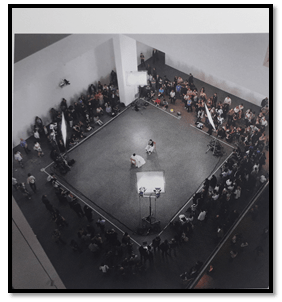
Marco Anelli,in Goldberg, 2018, p.15
And the effect is incredible considering the simplicity of this artistic act. The people waiting to sit in front of her must also accept the visual experience of seeing others interacting. Some of them sleep on the pavement in front of the museum and they can’t see her if their turn does not come until the museum is open. In the same documentary it is revealed one visitor stood with the artist a full day, 7 hours. Other were stopped trying to get naked or cover their own face with a bullet in a frame. But these exceptions don’t reveal the true power of the gaze shared between over 1.500 visitors and the Serbian artist. One of those visitors was Ulay, whom she met in that day after separating 23 years before during a performative experience on The Great Chinese Wall. With all the promise of stillness that was kept 3 months, over 700 hours of stoic gazing, in that first day of the show, when Ulay came, they hold hands. An affectionate moment that touched the sensitivity of all fans of their work, present or not there. However, it was the gesture of closing her eyes after each visitor and opening them again when a new visitor appeared, that will stay with me.
About her discoveries after one of the performance days, the artist mentions in the documentary:’are different reasons they sit in front of me (..) so many people have so much pain (…) I am the mirror of their own self’.
To prepare for this stillness in dialogue, the artist created the context of performance art all her life. Born in 1946, in Belgrade, at that time inside Yugoslavia [now Serbia], she developed her work around her own body. From the relationship with oneself in a ritualized way of inflicting self-abuse, to the exploration of a disconnected body and mind, the resistance inside enduring tests inside her own personal relationship, her whole life is her art. Of course, people will want to meet her, no screen involved, not inside a media story or a poster, but her aura, her tears, her smile, herself.
In the documentary, when she is preparing the students for the reperforming of her work she stresses the importance of silence, of fasting and of inactivity. She repeats herself in saying: ‘The hardest is to do nothing’. On the other hand, she speaks about ‘the very own charismatic space’ created by the performer that might offer a response that is very personal for each of those present there. That is because, as she mentioned in a different interview, for the Louisiana channel: ‘ I like to give people tools to get to themselves’.(Marina Abramović -Electricity passing through, 2017)
In ’Ways of looking’(Ward, 2014, p.88) the Serbian artist’s piece is described as a ’great occasion for the encouragement of the act of looking ‘ as ‘’Abramović’s performances demand more attention and interaction from the casual onlooker’’. That means the art is contained inside the middle terrain formed by the actual body of the viewer and the body of the artist. With their memories of their life story being actualized in a present moment of silence. As to oppose the noisy life of the city of New York.
In my view, her work can’t be understood without connecting it with personal details she expressed in the interview with the Louisiana channel. The interest in spirituality and religion borrowed from her grandmother and the discipline and a love for organized mind taken from her parents seem to have created a solid base for her usage of her own body as measure for interacting with her audience/viewers but also to be connected with the history of wars, mistreatment of the women body and the invention of an artificial way to consume reality and human relationships: capitalism.
Performance becomes an ideal medium for allowing to say the myriad ideas coming from this growth. In the third edition of a history of this art, ’Performace Art-from futurism to the present’ (RoseLee Goldberg, 2011, p.226) mentions that at the beginning of 20th century ‘’ It was no longer sufficient to cast a spotlight on cultures beyond the limited geographic reach of the past and to bring them into museums and galleries in the form of survey exhibitions.’’ This let us imagine the need for performance art to experience contemporary artists and their contemporary contexts made the public travel overseas, around the globe to meet them/their body of work.
In the same time, above the personal story or the story of a damaged post war Belgrade and Serbia, she acknowledges in the same interview she created every time ’with space and time a context’ for her performances, inside where ’everything was possible’. For my own work, I would prefer to have no fear of failure, trust in what the interaction moment can bring, trust in a personal art and energy to prepare a strong mind as she manages to do. Even if I never considered doing myself performance art, the effort’s character put to test limits of the relationships we build as humans with our body and with the body of others carries inspiration in a vast majority of the contemporary art and will stay valid for us, as artists as long as the human still have to carry a body in this life.
Reference list
Kapuściński, R (2018) The other, London-New York: Verso
Press statement by the Department of communication, Museum of modern art, MoMA presents the first large scale U.S. performance retrospective of MARINA ABRAMOVIĆ’s work,2010. [online] Available at: <https://assets.moma.org/documents/moma_press-release_387201.pdf> [Accessed 10 May 2020].
Youtube movies (2013), Marina Abramovic: The artist is present, Available at: <https://www.youtube.com/watch?v=WKw5eXIfNaU > (Accessed 1May 2020).
Louisiana Channel, Louisiana Museum of Modern Art (2017) Marina Abramovic-Electricity passing through, Available at: <https://channel.louisiana.dk/video/marinaabramovic-electricity-passing-through>(Accessed 12 May 2020).
Ward, O. (2014) Ways of looking-how to experience contemporary art, London: Lawrence King Publishing
Goldberg R. (2018), Performance now, United Kingdom: Thames and Hudson, p.15, illus.
 Petronela-Elisa Citea