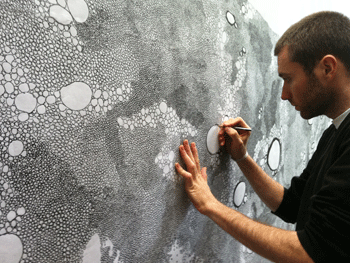
The participation of the audience is taken not just as a pretext to present the work of the artist but also to test and explore the limits if that artwork. Along the history of art, tides of interest followed the subject of dialogue. Sometime the artist is not aware he needs the public to interact with the piece. This is the case for Sam Winston and his work ”Birthday” 2010.
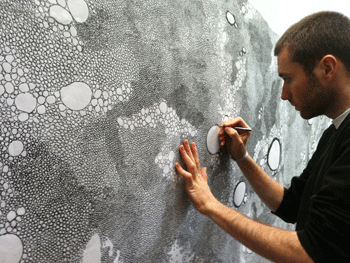
In ‘Art and religion’ (Rrosen, 2015, p.179) he started having in mind time expressed like that:’ By the time you’ve read this sentence three people have been born into the world. By the time you’ve read this sentence two will have passed away. Birthday is a work which sets out to record every individual birth and death over a twelve hour period—with a small circle.’ But he soon saw the task was huge so in the same book we find out ‘after recognizing the immensity of the task before him, Winston opened the process to the public, turning this private meditation into an act of collective commemoration and materialization’
The piece was exhibited in Bristol as part of the Mayfest (14 – 24 May 2010) and it gathered a big audience. What it is of interest for me is how simple the gesture he proposed is and how meaningful it becomes when speaking about a recollection of life and death. It seems like a metaphysical impossibility but the work managed to gather strangers to commemorate other strangers. Those who lived and died transformed were into a crowd of circles while those who made them became a crowd of patient, aware of life’s memento mori .
For my own practice I already started to plan occupying space and inviting others to write about the time that passes. This is because when in lock down, time seems less of a friend then how it was when I was without lock down. In Winston work I really appreciate his commitment and passion for mechanical and very physical efforts. He works with collage, decoupage, assemblage and drawing and his passion is seen in all of his work.
These days I miss dialogue and the blog will try to manage the eagerness to visit art spaces and experience cultural events. Kapuściński’s (2018, p.68) writings brings hope as the effort to wait for such an encounter is not in vain.
”The philosophy of dialogue is the movement, orientation or trend that tries to address the issues of man-the Self, and extremely crucially, his relations with another person, with the Other.”This postmodern reorientation from issues that are strictly ontological to broader ethical issues present in one’s life will be of interest always for the artist. My focus here is to find those artists that don’t use a lot of technology from the virtual and AI sphere to engage with the public.
List of references
Sam Winston(2010), Birthday, Available at <https://1936304petronelaelisacitea.photo.blog/wp-content/uploads/2020/06/a51db-samwinston.png>( Accessed 1 June 2020)
Rrosen, A. (2015)’Art and Religion in the 21st century’, London: Thames and Hudson
Kapuściński, R (2018) The other, London-New York: Verso
 Petronela-Elisa Citea