
Antony Gormley (born in 1950 in Dewsbury Moor, Dewsbury, West Yorkshire, England) uses mostly sculpture to express a dialogue with the viewers body. Usually he is using his own body to mold his life-sized iron bodies. He studied archaeology, anthropology and art history, immersed inside Buddhism in India and Sri Lanka and managed to study for a degree in fine arts and sculpture. Talking about his inspiration, in a in interview for the documentary the Eye (2002), Gormley proposes the perception of his body ‘’not as an abject but as a space’’ and he continues defining the skin as ‘’the border between between substance and appearance’’. For him the body is a place that hosts events and because he wants his to engage with everyone, I want to include here his work called ‘’ Blind Light’’ from 2007.
The character of this work is an installation in the shape of a cube made of glass that sculpts steam inside. The experience of the artwork is described in ‘’Contemporary Art Book’’ (Bonham-Carter, 2009): ‘Visitors who enter it [the cube] are blinded by the steam and so they stumble around, unable to get their bearings.‘ To better understand the journey inside the installation I followed a YouTube (ToineVB, 2007) video that covered the visit.
The quantity of steam presented there does not allow steps in any direction. Once entering there, the hands and feet look for a support to carry the body on the other side. Some people find strangers bodies to lean on while others stay in permanent contact with one of the lateral walls of the structure, trusting that this will save them soon from unknown.
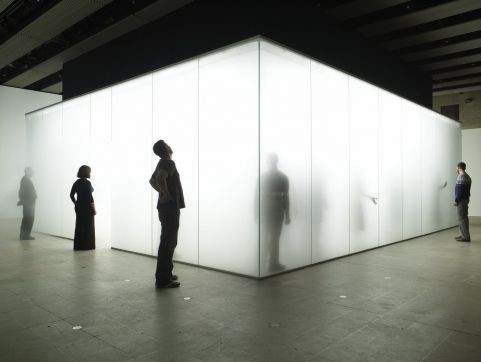
About this artwork, Bonham-Carter admits: ‘in opposition to the notion of <visual art> this piece is about invisibility and privilege, a perception that must include the body’ (Bonham-Carter, 2009, p.90.) Gormley, on his personal webpage (Antony Gormley, 2020), describes this piece more precise: ‘Architecture is supposed to be the location of security and certainty about where you are. It is supposed to protect you from the weather, from darkness, from uncertainty. ‘Blind light’ undermines all of that. You enter this interior space that is the equivalent of being on top of a mountain or at the bottom of the sea. It is very important for me that inside it you find the outside. Also, you become the immersed figure in an endless ground, literally the subject of the work.’
And this is a feeling no one can escape from, as the quality of the steam is aggressive in its persistence and power to enter quickly inside one’s body. This could be a moment when the crowd, as it becomes the ‘subject of the work, as Gormley said, it meets another ‘body of work’ and if they both go outside the work has no body. Literary the crowd can steal or borrow their body for the relationship with the space to happen. I still wonder why the artist has humanized the light by associating blindness to it?
Like Eliasson’s choice of elements, here Gormley transforms the natural element water. By playing with the vulnerability of the eyes that can’t see, the crowd accepts that in this incased cloud they might feel lost. And they might feel their body is hidden also. This uncertainty is well dosed here and I think, even if for a few meters, this participant had to trust somebody will need help and give help to go out from that room. The journeys that Gormley is sending his visitor are inspiring, but just on this occasion he worked with steam. Usually, iron or concrete are his material of choice. He appears to have a sort of certainty that I miss sometimes in my work about his tools and his messages. It sends me some idea inside my own work to think what the body is of the individual and how it is different from the body of the crowd…
Reference list
The Eye (2002), VHR [film] United Kingdon: Illuminations
Bonham-Carter, C.,Hodge D. (2009), Contemporary Art Book, London: Carlton Books
Toine VB (2007), The blind light, Available at <https://www.youtube.com/watch?v=Bd8EGK2kZeU> (Accesed 26 May 2020)
Gormley, A. (2020), Antony Gormley, Available at < http://www.antonygormley.com/ (Accessed 28 May 2020)
Gormley, A.(2007), Blind light, London: Carlton Books
 Petronela-Elisa Citea